Area-1255 ~Logo~

Tuesday, May 13, 2014

Re-Igniting and (Possibly) Finishing the Search for the "Dopaminergic Pot of Gold"


WARNING : Everything you read here is theoretical and for educational purposes, you may read and absorb, but do not take the methods literally. If you happen to do this, you should understand the potential side effects (behavioral changes, blood pressure elevation and delirium). I do not recommend anyone try this concept in it's entirety until you know how each bit and part will affect YOU. Just because the concept may work for me or someone else, doesn't mean it will benefit YOU. 


:::::Maximizing GABA is ESSENTIAL to this, you will get anxiety if you don't keep your Adrenaline in Check::::

!!! This does not mean take massive doses of KLONOPINE or XANAX !!!

It means, naturally do everything to keep your GABA levels elevated, or do what it takes to keep GABA elevated. Otherwise these methods will not work properly.

One more thing, it is absolutely essential that you keep an Anti-Nausea drug - namely ZOFRAN on hand while experimenting. 
In fact DO NOT even BEGIN the application of ANY of this without that drug, you might want to take Zofran before even using the first compound. 


The GOAL of the Dopaminergic Pot of Gold, is to create a Euphoric and Intelligent state, resembling that of a Amphetamine Rush perhaps, but while maintaining BP and a healthy heart. This state of mind may rapidly increase feelings of Unlimited Power, and Invincibility, and will enhance your body and mind to a state - unprecedented. It represents one part of a "Perfect Chemistry". 


Read the WHOLE ARTICLE, and the Citations. 


I was reading through a topic on "Dr.Bob" one day ; a long discussion about the recreational/intentional enhancement of dopamine levels, it was interesting to find they had referred to this premise as "The Dopaminergic Pot of Gold". This isn't the first time it has been brought up either - people seem to see Dopamine as being an all-powerful neurohormone that transforms your conscience into that of a deity. Bluelight and psychedelic forums are two other notable discussion area's where I've seen this brought up.
I don't disagree. People have been trying to dig up this kind of information for a long ass time.

IN FACT, I am one of them, you might even say I've gone "above and beyond", being a natural perfectionist - I've longed to see the results of dopaminergic enhancement through every possible mechanism.


One is described below.
5-HT2A antagonism, now what does this do?
Well 5-HT receptors are SEROTONIN receptors, the 5-HT2A/2C are inhibitory upon dopaminergic neurotransmission - "notably in reward area's such as the Ventral Tagament (VTA) and Hypothalamus". The activation of these receptors are associated with increases in cortisol and prolactin - which also lower dopamine levels.

Besides enhancing dopamine, 5-HT2A/2C blockade is useful for another reason. Lowering Blood Pressure.
You see, when you activate 5-HT2A/2C - this in turn activates Phospholipase C and Protein Kinase C - both of these are vasoconstricting enzymes. (2)(3)(4)

We wouldn't want to have High Dopamine and high blood pressure anyway - would we? Depending on your Dopamine > Norepinephrine (NORadrenaline) conversion, this might under normal "dopamine enhancing circumstances" become a reality.


Posted by Brainbeard on July 2, 2009, at 16:14:09
 At the end of the rainbow? Perhaps. It has only lately occurred to me that, in my desperate and frantic searching for a way to enhance dopaminergic functioning, I have overlooked or at least wasn't aware of a particular way of raising dopamine (DA) (and noradrenaline (NA)) levels and/or firing, namely 5HT2A/C-antagonism. Stephen Stahl opened my eyes. I knew that a low dose of Prozac raises DA (and NA) levels in crucial parts of the brain, but I didn't know it did that because of 5HT2C-antagonism. I've experienced that low dose Risperdal, which I thought was supposed to help with anxiety, turned me into a social superman besides boosting my 'mental libido' (the part between the ears as opposed to what's going on below the belt) - without doing much for anxiety. I now understand that because of Risperdal's 5HT2A-antagonism, it indeed elevates dopamine levels, resulting in mentioned phenomena. There is a nice presentation by Stahl on the web where he explains how 5HT2A and -C-antagonism result in increased dopamine release. I can't give a direct link because it seems to be a subscription page; nevertheless, when you follow the following link and click on the first search result, you do end up in the presentation: http://www.google.nl/search?hl=nl&safe=active&rlz=1B3GGGL_nlNL255NL258&q=Schizophrenia%3A+From+Circuits+to+Symptoms+Presented+by+Stephen+M.+Stahl&btnG=Zoeken&meta= Quoting from the presentation: 'What receptor properties can enhance the ability of an atypical to improve mood and cognition? What does the 5HT2A antagonist property have to do with that? Normally, the serotonin neuron (...) talks to the dopamine and norepinephrine neurons and tells them to be quiet, to step on the brake. If you interfere with that, you don't inhibit anymore; and, if you don't inhibit anymore, you disinhibit, which is a fancy way of saying, "turning it on." So, to disinhibit means not another way to do it, but rather to turn things on. If you block the natural ability of serotonin to stop norepinephrine and dopamine release, you enable the dopamine and the norepinephrine to be released. So blocking this causes release.' And: 'What other receptor binding properties might enhance this ability, besides those of 5HT2A? We get into some speculation, but useful speculation. The 5HT2C receptor is also connected to the dopamine and to the norepinephrine neurons, and it also reduces those through gamma-aminobutyric acid (GABA) interneurons; if you block them, it also increases dopamine and norepinephrine.' For this reason, Stahl explains, low doses of both Prozac (fluoxetine) and ziprasidone (Geodon) can be activating, because they block 5HT2C and/or 5HT2A without much (or any) serotonergic (Prozac) or antidopaminergic (Geodon) action going on. Furthermore, 5HT1A-agonism seems to be essential to complete the trick: 'Any other properties? The 5HT1A agonist properties could be useful. Presynaptic actions could help antidepressant effects, and postsynaptic actions could help cognitive effects. Dr. Meltzer has done seminal work showing that you don't get these increases -- of the good, smart neurotransmitters of dopamine and norepinephrine, particularly dopamine -- unless you work through a 5HT1A receptor.' Stahl gives extensive descriptions of these phenomena in his Essential Psychopharmacology, fragments of which can be read on the web, for instance here: http://books.google.nl/books?id=cWbYxSfKN3cC&pg=PA351&dq=Stephen+Stahl+5HT2A-antagonism+dopamine+5HT1A+serotonin In Depression And Bipolar Disorder, he explains the link between 5HT1A-agonism and 5HT2A/C mediated DA release: http://books.google.nl/books?id=zqvVZOea2JAC&pg=PA120&dq=Stahl++stimulation+of+serotonin+1A+receptors+acutely+reduces+the+serotonergic+inhibition+of+DA (read the text UNDER the small text belonging to the picture). Here's a research abstract that shows that 5HT2A-antagonism revives SSRI-decreased noradrenergic firing: http://www.journals.elsevierhealth.com/periodicals/bps/article/PIIS0006322306006597/abstract So, all the moaning and whining about SSRI-induced apathy could once and for all be abolished if SSRIs would standardly get served with 5HT2A/C blockade plus 5HT1A-agonism. And this is where things get dirty. There ARE pure 5HT2A and/or -C antagonists, but they don't have enough marketing potential since as stand-alone's they're not very impressive. So they are only known under desperately unimaginative names like SR46349-B. The 5HT2A/C-blockers that HAVE been marketed are for the bigger part pretty dirty drugs, which is to day, they have affinity for a range of receptors and do a dozen of things simultaneously, often in a dose-related manner. The atypical antipsychotics (AAP's) are almost all characterized by 5HT2A-blockade. See this table for a comparison of antipsychotic beinding data: http://www.nature.com/npp/journal/v28/n3/fig_tab/1300027t1.html Risperdal, mentioned earlier, is a potent 5HT2A-blocker, but because it crosses the blood-brain-barrier, even at low doses it raises prolactin levels wildly. Let me assure you, hyperprolactinemia is not something to take lightly. 


It can cause tumors or make your bones brittle. In my case, it leads to gynecomastia, which isn't fun when you're not a travestite with Pamela Anderson as your role model. Zyprexa is an excellent 5HT2A and -C-blocker, but it's a much too strong antihistaminergic - what use is extra DA and NA when you're sleeping all day - and strongly diabetogenic on top of that. Geodon (ziprasidone) is an interesting candidate since it's a strong 5HT2A-blocker, a relatively strong 5HT2C-blocker, a weaker 5HT1A-agonist, AND its antagonistic touch of D2 is soft enough not to raise prolactin levels much or cause extrapyramidal symptoms even at therapeutic doses. Geodon is also a moderately strong serotonin and noadrenaline reuptake blocker. Stahl refers to it as sort of a mini-Effexor. Its withdrawal syndrome, though, doesn't seem to be very mini if you may believe the anecdotal evidence. Anyway, Geodon (ziprasidone) is an interesting candidate for augmenting SSRI-therapy in a low dose - perhaps less than 20mg would already be enough? At such a dose, the whole cascade of the drug's other actions would hardly yet be put into motion. An even more interesting candidate, in my opinion, would be sertindole, which is a potent 5HT2A/C-blocker that touches D2 only lightly in comparison. In contrast to Geodon, that has a very short half-life, sertindole has a long half-life and it's blocking effects on 5HT2A are reported to be long-lasting. Sertindole was temporarily withdrawn from the market after reports of sudden death and the like because of its tendency to prolong QT-interval; later studies revealed, however, that this tendency wasn't any greater than that of most other AAP's; Risperdal, for instance, is a worse offender when it comes to QT-interval-prolonging. Anyhow, the QT-interval-prolonging is dose related, and I think that even a 4mg dose (therapeutic dosage for schizofrenia is >20mg) would be enough for the goal I have in mind. Sertindole, sadly, is considered a second-line treatment and hasn't even been investigated, it seems, as an augmentation strategy for SSRI-treatment. So who will ever prescribe it for me?! Then you have the good ol' TCA's, of course, most of which throw in a bit of 5HT2A or -C antagonism among all the other stuff they're doing. You can see and compare their 5HT2A-antagonistic properties in this table: http://www3.interscience.wiley.com/cgi-bin/fulltext/121665024/main.html,ftx_abs#t3 When you remember the (A)AP-table, you will realize that the 5HT2A or -C antagonism of the TCA's is rather weak and will probably only come into full play at therapeutic rather than low doses. That's a pity, because at such doses the side-effects of TCA's are so severe that only the truly heroic stand their ground. Which leaves the rest tantalized. Amitriptyline, for instance, has perhaps the best ratio of SRI versus NRI versus 5HT2A (and -C)-blockade. But it's a stronger antihistaminergic than Zyprexa (see there), and it's a very strong anticholinergic, and a very dirty drug overall, so though certainly undeserved, it IS imaginable that some doctor's have called the drug 'rat poison'. To draw towards the end. My personal suggestion (towards myself, that is) for a fine antidepressant cocktail with both anxiolytic and stimulating and motivating qualities would be: sertraline (Zoloft) + sertindole or ziprasidone (Geodon) or, if those aren't available, Risperdal + Buspar (buspirone), the 5HT1A-agonist. On paper, it looks good. What do you think?

Trazodone or Remeron <-- both are POTENT 5-HT2A antagonists, only Remeron has affinity for 2C.


I think you are correct you insightful poster. Good to see kids are still learning!
Now to dig a little further.
The research on autoreceptors.

Dopamine auto-receptors, that is.


                                      2008 Oct;28(8):1480-90. doi: 10.1111/j.1460-9568.2008.06450.x. 
Chronic activation of the D2 dopamine autoreceptor inhibits synaptogenesis in mesencephalic dopaminergic neurons in vitro.

Fasano C1, Poirier A, DesGroseillers L, Trudeau LE.

 Abstract

Chronic blockade or activation of dopamine receptors is critical for the pharmacological treatment of diseases like schizophrenia, Parkinson's or attention deficit and hyperactivity disorder. However, the long-term impact of such treatments on dopamine neurons is unclear. Chronic blockade of the dopamine D2 receptor in vivo triggers an increase in the axonal arborization of dopamine neurons [European Journal of Neuroscience, 2002, 16, 787-794]. However, the specific involvement of presynaptic (autoreceptors) vs. postsynaptic D2 receptors as well as the molecular mechanisms involved have not been determined. Here, we examined the role of D2 autoreceptors in regulating the ability of mouse dopamine neurons to establish axon terminals. Chronic activation of this receptor with quinpirole, a specific agonist, decreased the number of axon terminals established by isolated dopamine neurons. This effect was accompanied by a decrease in dopamine release and was mediated through inhibition of protein kinase A. The decrease in axon terminal number induced by D2 receptor activation was also occluded when the mammalian Target of Rapamycin pathway of mRNA translation was blocked. Our results suggest that chronic activation of the D2 autoreceptor inhibits synaptogenesis by mesencephalic dopamine neurons through translational regulation of the synthesis of proteins required for synapse formation. This study provides a better understanding of the impact of long-term pharmacological interventions acting through the D2 receptor.

PMID: 18973573 [PubMed - indexed for MEDLINE]


What does this all mean...?
Well basically autoreceptors are the brain's own receptor based negative feedback system for dopamine; telling the brain "we are having too much dopamine activation, let's decrease and / or moderate the release of by this receptor). It's a built in wiring "insurance policy" ensuring that dopamine increases will always be associated or followed by a decrease.


______________________________________________________________
__________________________________________________________________________

Point is. Dopamine D2 has two receptor subtypes, pre-synaptic D(2) Short (S) - "D2S" - receptors which INHIBIT dopamine - and Dopamine D(2) Long - "D2L" which activate their own actions. 


In light of this - there aren't many compounds that actually block dopamine auto-receptors besides Amisulpride, and only at lower doses, at higher doses it acts as an AntiPsychotic drug and blocks them all. Point being - Dopamine D2 has two receptor subtypes, pre-synaptic D(2) Short (S) - "D2S" - receptors which INHIBIT dopamine - and Dopamine D(2) Long - "D2L". Blocking ONLY D2S's - due to the fact that there aren't many compounds AVAILABLE - you would certainly need to experiment with low dose Amisulpride. However there are "pathways" that need to be ensured before we even get to that.


Also - IN ORDER TO UNDERSTAND DOPAMINE PRODUCTION AND FEEDBACK - we need to understand the CENTRAL MECHANISM and following effects of D(2) like RECEPTORS. 

SPECIFICALLY, Dopamine D(2) receptors INHIBIT adenlyl cyclase - which then INHIBITS - CYCLIC ADENOSINE MONOPHOSPHATE (cAMP) - which then the decrease of this (since cAMP normally stimulates the Enzyme TYROSINE HYDROYXLASE) decreases TYROSINE hydroxylase ; the enzyme by which dopamine is produced from the amino acid TYROSINE. Cyclic AMP is positively correlated with Protein Kinase A activation.

Thus - CYCLIC AMP is KEY to activating dopamine activity, and since Cyclc AMP is related to THYROID function, there is a STRONG link between associated thyroid hormones (such as T4 and T3) and dopamine synthesis.


Brain Res. 1988 Jul 26;456(2):302-9.

Evidence that adenosine A2 and dopamine autoreceptors antagonistically regulate tyrosine hydroxylase activity in rat striatal synaptosomes.

Onali P1, Olianas MC, Bunse B.

Abstract

Incubation of rat striatal synaptosomes with the adenosine receptor agonist 2-chloroadenosine (2-CADO) produced a concentration-dependent increase of dopamine (DA) synthesis (about 50% of control value). The effect was not additive with the stimulation produced by either 10 microM forskolin or 2 mM dibutyryl cyclic AMP. Pretreatment of striatal synaptosomes with 2-CADO produced an activation of tyrosine hydroxylase (TH) which withstood washing and lysing of the tissue. This activation was largely independent of the presence of Ca2+ ion in the preincubation medium and, when analyzed as a function of different concentrations of the pterin cofactor 6-methyl-5,6,7,8-tetrahydropterin (0.08-0.4 mM), it was associated with an apparent increase in the Vmax of the enzyme. Quinpirole, a selective D2 DA receptor agonist, reduced control synaptosomal DA synthesis and caused a persistent inhibition of TH activity. When added together with 2-CADO, quinpirole depressed the stimulation of DA synthesis and TH activity produced by the adenosine analog. The effect of quinpirole was stereospecifically antagonized by the D2 DA antagonist sulpiride. Quinpirole also inhibited the activation of TH elicited by a submaximal concentration of forskolin, but not that produced by dibutyryl cyclic AMP. The inhibitory effect of quinpirole on basal and 2-CADO-stimulated TH activities was mimicked by DA. These results indicate that presynaptic DA autoreceptors and adenosine A2 receptors interact antagonistically in controlling DA synthesis in rat striatal synaptosomes presumably by exerting opposite inputs on a presynaptic adenylate cyclase system. PMID: 2905190 [PubMed - indexed for MEDLINE]


Now there are many ways to increase Cyclic AMP.
One of those is by supplementing with a compound called "Forskolin" - a direct adenylyl cyclase ACTIVATOR. As one of the supplements that activate adenylyl cyclase - we will expect as seen above, an INCREASE in cyclic AMP. Now we have more tyrosine hydroxylase - and thus more DOPAMINE.

As another big note ::: None of this will apply if you aren't getting the necessary amino acids in your diet!!!! 
Therefore, if you attempt to apply any information in this article, remember that PROTEIN intake is ESSENTIAL! I suggest eating a handfull of peanuts and getting the rest of your protein from lean meat.


Let's review so far.

Methods of increasing dopamine activity.

  • Blocking/Antagonizing 5-HT2A / 2C receptor activity.
  • Blocking auto-receptors using low - dose amisulpride.
  • Increasing Protein Intake
  • Supplementing with Forskolin.

The next one is kinda like hitting two birds and a squirrel with one jagged stone.


Why Yohimbine...?

For good reason - it blocks many serotonin receptor subtypes that have detrimental effects on dopamine synthesis and also cause vasoconstriction. Some of these are the serotonin 5-H1(B) receptor, 5-HT1(D) receptor and 5-HT2(B) receptor. That means that by blocking serotonin's effect on these receptors, Yohimbine allows for both vasodilation and dopamine release.


Second to all of this - Yohimbine blocks Central Alpha-2-receptor's VERY POTENTLY.
By blocking Alpha-2-Receptors, dopamine release is enhanced.


So just with the triple triple cocktail of Yohimbine, Trazodone (or Remeron) and Forskolin we have a super boost in dopamine. Add in ami sulpride at very low dose - and we've enhanced it even more.


Now let's move to other aspects of dopamine's breakdown.


MONOAMINE OXIDASE ACTIVITY

Monoamine Oxidase type A - is an enzyme that breaks down Catecholamines/Monoamine's; dopamine, epinephrine, norepinephrine and serotonin. Monoamine Oxidase also has a type B ; and this breaks down Dopamine and Phenylethylamine ONLY.

To maximize dopamine, both of these enzymes should be inhibited.
However, we are starting to cross the red river here as far as side-effects.
Always keep an alpha-blocker on hand, no-one should be applying any of these concepts without having an anti-nausea/sympatholytic drug on hand.

VERY IMPORTANT : Wiping out MAO-A and MAO-B does NOT require drugs AT ALL. 
They are ANTIOXIDANT based enzymes, the more antioxidants you have in your blood, the less of these enzymes that break down dopamine and EPI etc.


To inhibit MAO-A and MAO-B ...you only need two products.
Syrian RUE and KAVA KAVA.

Syrian Rue can be found here ---> Herbs of the Gods
KAVA KAVA can be found ---> HERE


NEXT ASPECT OF DOPAMINE BREAKDOWN...


DAT (Dopamine Transporter)
To inhibit this transporter which will then allow for more dopamine to stay active (and not get used up quickly) - we need transporter inhibitors (specifically DAT and NET inhibitors).

NET is norepinephrine transporter...why inhibit this? Because dopamine is INACTIVATED by NET in certain area's of the brain...very important area's in cognitive processing and emotions such as Prefrontal Cortex. So to REALLY maximize dopamine...we would have to block both DAT and NET...which locks both dopamine and norepinephrine into the synapse. ALWAYS KEEP AN ALPHA BLOCKER ON HAND. So you don't get high BP....you should be only the HEALTHIEST of an individual to try these methods out. 


To inhibit both DAT and NET...

We only need one or two HERBS.


Kava inhibits both NET and MAO-B, while Catuaba inhibits DAT.


Now with all the methods listed so far.

We only have ONE method left..one little trick left in maximizing dopamine to absolutely SUPRAPHYSIOLOGICAL concentrations.

A transporter called "VMAT".


VMAT is what Amphetamines bind to. But we don't need amphetamines.
We only need one substance. The natural form of amphetamine already present in our body.

PEA - Phenylethylamine. If we take this orally, while inhibiting MAO-B...then we have already done our deal with the devil..because MAO-B inhibition ensures PEA stays around...which means we ENSURE VMAT Inhibition!


There is one little feeback mechanism NOT mentioned yet...


NMDA-receptors. When you interfere with NMDA glutamate receptors, you will actually indirectly block the reuptake of dopamine, leading to enhanced dopamine Activity.


click here now

Area-1255's Recommended Affiliate Programs.

Quick and to the Point. 
Area-1255's Recommended Affiliate Programs
(#1)

(GO TO "Affiliate Program")

Unique because it promotes a hormone replacement gel not sold anywhere else on the Internet. (DHT Gel, Andractim). Prices are at a rate that will attract buyers and yet create you a bigger wallet.


(#2)

Great diversity of products, and you get bonus's for referring over 6 products a month.


(#3)
IDM - "International Drug Mart"

Very good prices on meds and always well-stocked - broad selection of Meds that makes for an easier time marketing. 

Best Affiliate Programs For Fast Money Online (and Explaining Affiliate Programs for Beginner's)

Today I am going to show you one way you can make money online, I know there are already several articles like this - however, most of them fail to mention specific techniques that are NECESSARY while "Affiliate Marketing", and they fail to point out some of the less-known but ideal affiliate programs for beginners.

First of all, let's explain an affiliate program.


An "affiliate program" is not a site where you spend time filling out surveys, or referring people to merely click on links. An affiliate program is a program where you get paid a certain percentage (commisssion) of a product's total cost, in exchange for referring new customer's to that company's (or site's) products. For example, if you are using Amazon's affiliate program, and you link someone to an iPhone being sold on Amazon, then that person buys the product, you will get approximately 10-15% of the cost of that product, paid to you after total's are calculated at the beginning of the next month.

So if you ask, "what is the goal when working for an Affiliate Program?" - it's simply to get as many people possible to buy as many of whatever product you are linkng them to. With virtually every affiliate program,  you will have your own "Tracker Link" which is used to identify you as the person who referred them to the product, this then allows the company to pay you for doing that.

For example, on Amazon's affiliate program - say you are referring people to an Apple iPhone 16GB (Gold) - the link you build to refer people off of will look like this.

http://www.amazon.com/gp/product/B00F3J4E5U/ref=as_li_tl?ie=UTF8&camp=1789&creative=9325&creativeASIN=B00F3J4E5U&linkCode=as2&tag=usernamehere-xx&linkId=O6XSX3VZATGGJ2L2


The part highlighted in black is your user name built into the link, so you can get credit for referring the person to the specific product - in red is the link, identifying product ID - which is Apple iPhone in this case. 

So this is how most affiliate programs work.
You can use multiple methods to support your success when using Affiliate Program's - the best method, is building a blog like mine here, or a full-blown website; domain registered and all. The goal is to get a lot of traffic to your site, then you just need to figure out a way to get people to click your affiliate links.


In order to effectively convince people, you should be a big fan of innovation. You should be interested in targeting new products that have just been released, or products that have yet to be reviewed, that way you can ensure top results on google and other search engines (providing you have placed the proper tags in your article or advertisement). What I mean by tags, are placing relevant keywords that you believe people will search. In relevance to the iPhone - you can write a review on it, and use a title like "is Apple iPhone worth it", since many people will search it in more subtle/casual terms.  Somewhere in the review, you can also write other keywords - like why a particular version is better than another. These are just examples, if your blog or site has a lot of traffic, you are likely to make ALOT of money !!!!


You simply have to be strategic, and know your audience.


Ok so now I have explained an affiliate program. Now am I going to tell you what (in my opinion) are some of the best affiliate programs to use. 

Let's start with an easy affiliate program that you can make quick (and big) money off of. It's a program promoting the drugs Viagra, Cialis, Levitra and a form of Testosterone Gel - known as Andractim. Andractim is actually DHT - if you have read my other articles(1)(2), you will already know what this is. The benefit of promoting such products, is the diversity of customer's, and though you may not think it at first, people use these drugs for other purposes than just treating Erectile Dysfunction, and other related problems. 

For example, this class of E.D drugs (PDE-5 Inhibitors), which work by increasing blood flow to peripheral organs, are also used by Bodybuilders to get a better pump when lifting. Similar to how "Nitric Oxide" products work, and PDE-5 inhibitors can even enhance the effect of all "Pre-Workout" and "N.O Supplement's", therefore they are used as synergist's and amplifier's of other supplements. As these effects become apparent (more blood flow, vasodilation), vascularity (the appearance of veins in muscles) also increases. Therefore some* bodybuilders may use (in combination with other products) these drugs as a pre-contest "enhancement". 

PDE-5 Inhibitors also can treat or cure Premature Ejaculation, many reports have supported this(3)(4). Therefore they can be used for this purpose as well, and this once again broadens the audience and customer line for these products.


To sign up, simply click the title in blue above, then go to "Affiliate Program" and click it, it will begin a page that looks like this. 

Note as I highlighted important parts.


Now after signing up, you will receive an e-mail about 24 hours later (or less), unless it is a weekend, and this e-mail will contain your login link (to view your stats and commissions), and the link you will give to others when promoting the products.

The e-mail will look like this.


NOTE : I've talked to some people (referred to this program) who have said it took 3 days to get their initial e-mail. So don't be surprised if this happens, generally it's pretty quick though.


NOW.


When you receive that e-mail, you can start marketing with the first link, be VERY CAREFUL to not give anyone the *second link* in that e-mail, because then they will have access to your personal information as well as your stats.


Hyperlinking is your best friend. Wherever you decide to advertise, don't just use your link in plain form, e.g 


http://www.secure-sales.org.uk/clinic/page.cgi?id=user name here


There you have it.

Now you just have to be tactical, and figure out your audience, and how to make your page different from the average person marketing these drugs. 

Try using a site like Fiverr.com, where you can pay someone 5$ to post your link on their Twitter or Facebook (typically having hundreds of thousands of followers).

Other suggestions, are emphasizing that this site does not require a prescription for the order, and also that it isn't "off-brand Indian garbage" as I always say.


It's always a good thing to promote high-quality products, and you want to be sort of honest (but not 100%). Think how marketing really works. Company's and representatives always exaggerate, though perhaps in a very covert way most of the time.


I also suspect there isn't a whole lot of lying you can do in regards to these specific products, as the information as to WHAT they do, is EVERYWHERE. But you can certainly notate certain descriptors as I do.


                                  ...... When you receive Commissions (as people click your link and buy the products) from this program, you will receive e-mails about them during the "pay-period" of the month, All Saints does this at different times but generally during the beginning of the month.


This is where it gets exciting...


Once those e-mails appear, your balance will be updated on your stats page and will look something like this....


As you can see, they pay in Euro's, but it will be appropriately converted to USD when they pay you, if you live in the USA.


The second affiliate program I recommend - is AMAZON AFFILIATE PROGRAM (made reference before as well).


SIGN UP HERE FOR AMAZON AFFILIATE PROGRAM


Why is amazon so special?

Well for a number of reasons. First and foremost. Diversity. You have a huge selection of product's throughout every single category - giving you leeway and allowing for maximal customization on your site.

Amazon also gives you bonuses for reaching a certain amount of referrals per month. This is where they really shine. Between the vast selection of products to refer on, the pre-loaded graphic designs (for the products) and the bonuses - amazon is a brilliant affiliate program that is also easy to newbie's and can generate a great amount of income for you and your business.

It's free to sign up, as most affiliate programs are.

Here is an example of an Amazon affiliate link with an Image.


elite proxy server

Wednesday, May 7, 2014

Debunking the Hoax - Testosterone Gel's and Products Causing Cancer

AND Without further or official introductions...that's what I'M CALLING THIS...and that's what I KNOW....and, MOST IMPORTANTLY that's WHAT THIS IS!!
A HOAX, a CAMPAIGN started because of DECEPTION in the industry, and the saddest error of judgement!
 ...A campaign that is partially true, but only because people are MISLED!!!


However I won't let my words alone be the judge. Let's look into this shall we? Follow me.
                                                       ~Read along~
Just keep your bullshit alert on high, because I know in the end you will understand, hopefully.....
....That the ONLY BULLSHIT IS COMING FROM PEOPLE LAUNCHING THE CAMPAIGNS.
For once, I'm sticking up for *(kinda)* the pharmaceuticals....but I also would say this...people NEED TO DO THEIR OWN RESEARCH!!!!!


TESTOSTERONE ITSELF DOES NOT CAUSE ANY CANCER, PERIOD. 

If you look carefully into public medial journals, where some of these famous groundbreaking and heart shuttling observations were made - there was no specificity nor description of what forms of testosterone were used and if bloodwork was obtained...during and after treatment. It appears not at all in some cases.
In the real-life cases where bloodwork was not obtained and other values were not accounted for, I shame the doctors for that matter. However not all cases are the same - the problem we have is that there has not been ONE study showing that ANDROGENIC hormones; testosterone or DHT have been proven to cause any sort of CANCER themselves, in a setting where the men's estrogen VALUES were also LOW or OPTIMAL. I mean...you can say that studies have shown it...but the BIGGER ISSUE - is that ESTROGEN levels are hardly EVER accounted for or examined DURING the course of these studies. ESTROGEN has SIGNIFICANT growth promoting and DOCUMENTED EVIDENCE - of TUMOR PROLIFERATING (growing, replicating) properties!!!!

Estrogen excess is ALREADY implicated in BREAST CANCER, UTERINE CANCER, OVARIAN CANCER AND......  PROSTATE CANCER???

Well I'll be damned. Prostate Cancer...wanna have a look?
Estrogen action and prostate cancer

Jason L Nelles,1 Wen-Yang Hu,1 and Gail S Prins1,†


In a recent cross-sectional analysis, serum steroid levels were assayed in 1413 matched men of various races and while testosterone levels did not differ, African–American men had significantly higher serum estradiol levels than Caucasian or Mexican–American men, a difference that was most pronounced in early and mid-adulthood[29]. This is highly significant in that African–American men have a twofold higher rate of prostate cancer than Caucasian–American men, as well as a greater prostate cancer risk than Hispanic males. Studies on pre- and peri-natal exposure to estrogens have also raised concerns about their carcinogenic potential. Some authors have suggested that the higher incidence of prostate cancer among African–American men is partly due to in utero exposure to maternal estrogens since African–American women have higher circulating estrogen concentrations during pregnancy than Caucasian women [30,31], although gestational androgen levels are also elevated. Animal models of prostate cancer have demonstrated that, at least in rats, estrogen is a necessary, if not sufficient, condition for prostate carcinogenesis. Although rats do not naturally develop prostate cancer, it can be induced in Noble rats by combined treatment with estradiol and testosterone, with testosterone playing a supportive role since androgen supplementation alone is insufficient to drive carcinogenesis [32–34]. A recent review by Bosland reinforced this notion, citing an incidence of prostate cancer induction in Noble rats of 100% with testosterone and estrogen, but only 40% with testosterone alone.


Also here are the studies on Estrogen and Breast Cancer....
J Steroid Biochem Mol Biol. 2006 Dec;102(1-5):89-96.


Russo J1, Russo IH. 
The role of estrogen in the initiation of breast cancer.

Abstract
Estrogens are considered to play a major role in promoting the proliferation of both the normal and the neoplastic breast epithelium. Their role as breast carcinogens has long been suspected and recently confirmed by epidemiological studies. Three major mechanisms are postulated to be involved in their carcinogenic effects: stimulation of cellular proliferation through their receptor-mediated hormonal activity, direct genotoxic effects by increasing mutation rates through a cytochrome P450-mediated metabolic activation, and induction of aneuploidy. Recently it has been fully demonstrated that estrogens are carcinogenic in the human breast by testing in an experimental system the natural estrogen 17beta-estradiol (E(2)) by itself or its metabolites 2-hydroxy, 4-hydroxy, and 16-a-hydroxy-estradiol (2-OH-E(2), 4-OH-E(2), and 16-alpha-OH E(2)), respectively, by inducing neoplastic transformation of human breast epithelial cells (HBEC) MCF-10F in vitro to a degree at least similar to that induced by the chemical carcinogen benz(a)pyrene (BP). Neither Tamoxyfen (TAM) nor ICI-182,780 abrogated the transforming efficiency of estrogen or its metabolites. The E(2) induced expression of anchorage independent growth, loss of ductulogenesis in collagen, invasiveness in Matrigel, is associated with the loss of 9p11-13 and only invasive cells that exhibited a 4p15.3-16 deletion were tumorigenic. Tumors were poorly differentiated ER-alpha and progesterone receptor negative adenocarcinomas that expressed keratins, EMA and E-cadherin. The E(2) induced tumors and tumor-derived cell lines exhibited loss of chromosome 4, deletions in chromosomes 3p12.3-13, 8p11.1-21, 9p21-qter, and 18q, and gains in 1p, and 5q15-qter. The induction of complete transformation of the human breast epithelial cell MCF-10F in vitro confirms the carcinogenicity of E(2), supporting the concept that this hormone could act as an initiator of breast cancer in women. This model provides a unique system for understanding the genomic changes that intervene for leading normal cells to tumorigenesis and for testing the functional role of specific genomic events taking place during neoplastic transformation.


It's interesting, but I'm not the only one to say this. Recently Abraham Morgentaler, MD and his associates had published a VERY SIGNIFICANT article regarding these very studies and MORE!


For decades, the storyline was that lowering testosterone levels caused prostate cancer to shrink away and raising testosterone levels caused it grow. The second part of this story was now seriously in doubt, yet the first part was obviously correct. In my own practice, I had seen the beneficial effects of lowering testosterone levels many times over in men with advanced prostate cancer. This part of Dr. Huggins’s work was indisputable. But if lowering testosterone levels caused these cancers to shrink, how was it possible that raising testosterone levels did not cause the cancers to grow? This was a paradox that needed to be solved if physicians were to accept the possibility that testosterone therapy may not increase the risk of prostate cancer.

The Paradox Resolved

The answer turns out to be not all that complicated. All the reports of testosterone causing rapid growth of prostate cancer occurred in men who already had extremely low testosterone levels, due to castration or estrogen treatment. Once we get beyond the near-castrate range, it is hard to find any evidence that changes in T concentrations matter at all to prostate cancer. This is essentially what Drs. Fowler and Whitmore described in their 1981 article when they suggested that “near maximal” growth of prostate cancer is provided by naturally occurring T concentrations. The experimental proof of this concept was provided by a landmark article published in 2006 using much more sophisticated means. In this study by Leonard Marks and colleagues, men with low testosterone received injections of testosterone or a placebo every two weeks for a total of six months. At the beginning and end of the study, measurements of testosterone and DHT (the more active form of testosterone within prostate tissue) were obtained from the blood and also from the prostate itself. The results showed that although blood concentrations of testosterone and DHT rose substantially in the T injection group, as expected, the concentration of testosterone and DHT within the prostate itself did not change at all and was similar to the group that received placebo injections. In addition, biochemical markers of prostate cell growth also did not change with T injections. This study showed in elegant fashion that raising testosterone levels in the blood did not raise testosterone levels within the prostate. It is as if once the prostate has been exposed to enough testosterone, any additional testosterone is treated as excess and does not accumulate in the prostate. In technical terms, we say the prostate has been saturated with regard to testosterone. And it is this saturation that resolves the paradox of testosterone and prostate cancer. Saturation explains the paradox in this way. At very low levels of T, near the castrate range, prostate growth is very sensitive to changes in T concentration. Thus, severely lowering testosterone will definitely cause prostate cancer to shrink; adding testosterone back will cause the cancer to regrow. However, once we get above the point where the prostate is saturated with testosterone, adding more testosterone will have little, if any, further impact on prostate cancer growth. Experimental studies suggest the concentration at which this saturation occurs is quite low. In other words, the old analogy I learned in training was false. Testosterone is not like food for a hungry tumor. Instead, a much better analogy is, “Testosterone is like water for a thirsty tumor.” Once the thirst has been satisfied, prostate tumors have no use for additional testosterone. And the vast majority of men with low testosterone appear to have prostates that are not particularly thirsty.

A New Concern: Prostate Cancer and Low testosterone

I no longer fear that giving a man testosterone therapy will make a hidden prostate cancer grow or put him at increased risk of developing prostate cancer down the road. My real concern now is that men with low testosterone are at an increased risk of already having prostate cancer. When my colleagues and I published our results in 1996 from prostate biopsies in men with low testosterone and PSA of 4.0 ng/mL or less, the 14 percent cancer rate was several times higher than any published series of men with normal PSA. In 2006, Dr. Rhoden and I published a larger study of prostate biopsies performed in 345 men. The cancer rate of 15 percent in this group was very similar to the first study. But whereas the cancer rate in 1996 was much higher than anything published to that date in men with PSA of 4.0 ng/mL or less, in 2006 the perspective had changed due to an important study called the Prostate Cancer Prevention Trial. A New Concern: Prostate Cancer and Low Testosterone In that study, the cancer rate among men with a PSA of 4.0 ng/mL or less was also 15 percent. Because this value is identical to what we had found in our patients with low testosterone, it was suggested that the cancer rate in men with low testosterone is the same as the normal population—neither higher nor lower. However, the average age of men in our study was a decade younger than the men studied in the Prostate Cancer Prevention Trial (fifty-nine versus sixty-nine years). Almost half the men in the other study were seventy years or older, and age is the greatest risk factor we know for prostate cancer. The way I look at these numbers is that men with low testosterone have a cancer rate as high as men with normal T who are a decade older. More importantly, in our study of 345 men, we found that the degree of testosterone deficiency correlated with the degree of cancer risk. Men whose testosterone levels were in the bottom third of the group were twice as likely to have cancer diagnosed on biopsy as men in the upper third. This finding adds to the concern that low testosterone is a risk factor for prostate cancer. There is now additional data from around the world associating low testosterone and worrisome features of prostate cancer. For example, low testosterone is associated with more aggressive tumors.


In addition, men with low testosterone appear to have a more advanced stage of disease at the time of surgical treatment. Whereas I originally began to perform prostate biopsies in men with low testosterone because I was worried that treatment might cause a hidden cancer to grow, I now perform biopsies in these men because I am concerned they might have an increased risk of cancer. This risk is approximately one in seven for men with PSA values less than 4 ng/mL. Because prostate cancer tends to be curable when caught early, I feel I’ve done these men a service by finding their cancers before they have an abnormal PSA or DRE. With today’s ability to monitor men with prostate cancer, not all of these men will necessarily require treatment. But the ones who have evidence of more aggressive tumors should definitely have an advantage by having their diagnosis made early. The Evidence as it Now Stands For over sixty-five years, there has been a fear that testosterone therapy will cause new prostate cancers to arise or hidden ones to grow. Although no large-scale studies have yet been performed to provide a definitive verdict on the safety of testosterone therapy, it is quite remarkable to discover that the long-standing fear about testosterone and prostate cancer has little scientific support. The old concepts, taken as gospel, do not stand up to critical examination. I believe the best summary about the risk of prostate cancer from testosterone therapy, based on published evidence at the time this book is written, is as follows: Low blood levels of testosterone do not protect against prostate cancer and, indeed, may increase the risk.

High blood levels of testosterone do not increase the risk of prostate cancer. Treatment with testosterone does not increase the risk of prostate cancer, even among men who are already at high risk for it. In men who do have metastatic prostate cancer and who have been given treatment that drops their blood levels of testosterone to near zero, starting treatment with testosterone (or stopping treatment that has lowered their testosterone to near zero) might increase the risk that residual cancer will again start to grow. Prostate cancer with infiltration into bladder, lymph nodes, and urethra. Prostate cancer with infiltration into bladder, lymph nodes, and urethra. One of the most important and reassuring studies regarding testosterone and prostate cancer was an article published in the Journal of the National Cancer Institute in 2008, in which the authors of eighteen separate studies from around the world pooled their data regarding the likelihood of developing prostate cancer based on concentrations of various hormones, including testosterone. This enormous study included more than 3,000 men with prostate cancer and more than 6,000 men without prostate cancer, who served as controls in the study. No relationship was found between prostate cancer and any of the hormones studied, including total testosterone, free testosterone, or other minor androgens. In an accompanying editorial, Dr. Carpenter and colleagues from the University of North Carolina School of Public Health suggest scientists finally move beyond the long-believed but unsupported view that high testosterone is a risk for prostate cancer. More and more physicians are coming around to recognize that testosterone therapy is not a true risk for prostate cancer, but it can take many years to alter established beliefs. Don’t be surprised if your own doctor still raises this issue with you if you are considering testosterone therapy. If he objects to treating you for that reason, you should refer him to the article above, or one of the other review articles listed in the References at the back of this book. Even better, have him read this chapter!

Q. I’m fifty-three years old and I’ve been on testosterone therapy for two years, with good results. However, my father was diagnosed with prostate cancer at age seventy-five. Does this mean I need to stop testosterone?

A. There is a familial form of prostate cancer, but only in families in which prostate cancer occurs at age sixty-five or younger. Even in those families where a family member develops cancer at a young age, this does not necessarily mean that every other male in the family will develop cancer. Men with a family history of prostate cancer should be sure to have a yearly PSA and prostate exam. There is no need to discontinue testosterone treatment.

Q. My physician started me on testosterone, but I never had a prostate biopsy. I am sixty-four years old. Was this a mistake?

A. Because there is no evidence that testosterone treatment increases the risk of prostate cancer, it is fine to begin therapy as long as your PSA and DRE are normal. My own practice is to recommend prostate biopsy in men with low testosterone because our published data indicate there is an increased risk that cancer is already present in men with low testosterone, but this is by no means a standard recommendation yet among physicians.

Q. Why do you perform prostate biopsies on men with low testosterone if you don’t feel that testosterone treatment will make a hidden cancer grow?

A. Because so many men with prostate cancer will not die from it, even without treatment, there is a fair amount of controversy over how aggressive to be in making the diagnosis. My perspective is that it is worth knowing the diagnosis, whether or not one chooses to be treated immediately. And because low testosterone seems to represent a small but definite increased risk, I feel that biopsy in men over fifty with low testosterone is worthwhile.

Q. A man in my bowling league was started on testosterone treatment and then developed prostate cancer one year later. Doesn’t that show that testosterone is risky for prostate cancer?

A. If the wife of this man had switched to a new type of laundry detergent before the cancer was diagnosed, would we assume the cancer was caused by the detergent? Of course not. But we are predisposed to believe that testosterone therapy causes prostate cancer, so it is easy to hear a story like this and assume that testosterone therapy caused the cancer. Prostate cancer and testosterone therapy are both common in the United States, and both tend to occur in the same age range, so there will always be stories of men developing cancer some time after beginning testosterone therapy. If testosterone really made prostate cancers grow, then we should see high rates of cancer among men who start testosterone therapy. But we don’t. It’s false logic.

Q. Isn’t it true that all men would eventually get prostate cancer if they lived long enough? If so, why does it even matter if testosterone were to increase the risk of something that is inevitable anyway?

A. Men do get prostate cancer at an increasingly high rate as they age. And it is true that most men diagnosed with prostate cancer would never have a moment’s trouble from it, even if it were left untreated, because most of these cancers grow so slowly that other medical conditions eventually become more troublesome. Yet for those with more aggressive forms of prostate cancer, the danger is very real. The challenge is to identify men at risk, because even high-grade prostate cancer is curable when caught early.

Q. It took more than thirty years for scientists to learn that hormones were dangerous for women and caused breast cancer. Isn’t it possible we’ll eventually find out the same is true for testosterone and prostate cancer?

:::Abraham Morgentaler, MD Abraham Morgentaler, MD A::::

The fear that hormone therapy is dangerous in women is currently being reevaluated, and it appears to not be as dangerous as was originally proclaimed. More to the point, it is critical to understand that men are not women and that testosterone is not estrogen. Anyone, particularly a scientist, must always allow for the possibility that new information will one day change current views. But after so much research over so many decades, there is little reason to believe that testosterone therapy poses a major risk for prostate cancer. As a medical student once said to me, “If testosterone is really so dangerous for prostate cancer, why is it so hard to show it?”

Abraham Morgentaler, MD, is an associate clinical professor of urology at Harvard Medical School, and is the founder of Men’s Health Boston, a center focusing on sexual and reproductive health for men. He is the author of a number of popular books including The Male Body and The Viagra Myth. Excerpted with permission from Testosterone for Life: Recharge Your Sex Drive, Muscle Mass, Energy and Overall Health by Abraham Morgentaler, MD, FACS. Published by McGraw-Hill.


Therefore as you can see, I have a reason for arguments, they are VALID ARGUMENTS!

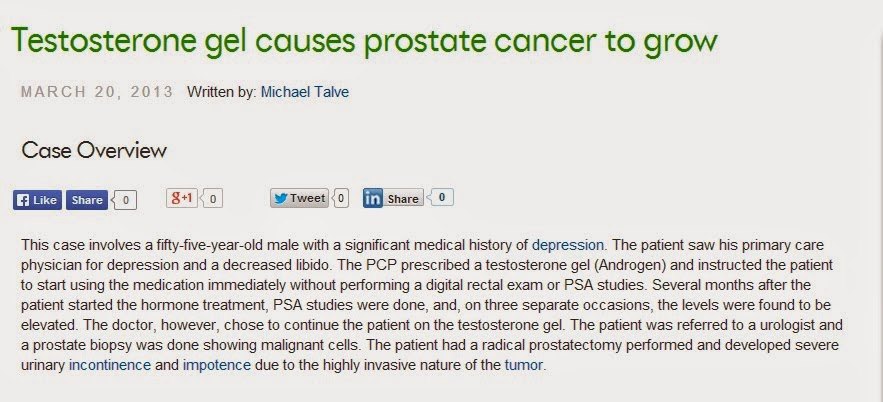
Excerpts such as this one...


You can clearly see the Doc was wrong for not performing the proper tests...however, it's the INACCURACY and lack of specification, and a lack of knowledge in the area that leads to false campaigns. The problem is - a simple fact, such as that Estrogen is MADE FROM TESTOSTERONE, is never considered in all of these accusations against testosterone...and Ya know, there ARE pharmaceutical drugs, that have gone through rigorous and extensive trials - called Aromatase Inhibitors, that do indeed, decrease or STOP conversion of Testosterone to Estrogen, which JUST SO HAPPEN to also prevent prostatic carcinoma's and cause apoptosis to human prostatic carcinoma. Thus...what does that say???

THAT IT IS ESTROGEN THAT CAUSES AND MUTATES CANCER 


Another study shows that Aromatase Knockout (estrogen deficient) mice do not develop prostate cancer.

LINK TO BOOK
Indeed, aromatase knockout mice, which are estrogen deficient but have increased levels of androgens, do not develop prostate cancer [90].


So in reality, there is an overwhelming body of evidence, when looked at correctly, and not in the deluded minds of Campaign artists - who's main goal is to make money, that ESTROGEN is the MAJOR FACTOR in PROSTATE CANCER.

Though I do agree that the victims who have fallen prey SHOULD be compensated, and that the Doctors who had not performed the proper testing (including bloodwork) should be corrected, what really needs to be done, is EVERY MAN ON TESTOSTERONE REPLACEMENT THERAPY, SHOULD HAVE THEIR ESTROGEN LEVELS CHECKED!!!!
If they turn out HIGH, or moderately elevated (ESPECIALLY, if you have GENETIC predispositions to Prostate Cancer), then you should proceed to ask your doctor for an "Aromatase Inhibitor"!!!!

KEEPING TESTOSTERONE HIGH, AND ESTROGEN REASONABLY LOW - WILL CERTAINLY ELIMINATE YOUR RISK OF DEVELOPING CANCER....


So there you have it....
The answer is NOT to PERSECUTE testosterone therapist's, Medical Doctor's (in most cases), or the manufacturer's of Testosterone Replacement Products, but to inform everyone, and anyone on these therapies, to DEMAND they get their estrogen level's checked, and to proceed when necessary, to request the appropriate counter-therapies for bad estrogen:testosterone RATIOS.


AGAIN...the "Victims" should be compensated - if their condition is severe, or even moderate...but that's not the ABSOLUTE answer...or the Preventative One.
The answer is keeping people INFORMED and using aromatase inhibitors when necessary.


If your doctor will not give you a script for (for some stupid reason) an aromatase inhibitor drug, there are places you can buy them online.

The best place to find aromatase inhibitor drugs online, and also where you can buy letro (letrozole) (most powerful aromatase inhibitor) online....
Well.. look below, best prices as well. You don't need to put up with that from your doc!!!

You can buy 20 tablets of Letrozole (the best AI) for 29 $  - HERE AT THIS SITE
On the same site you can find over a dozen other AI's.

Also for a High Quality Testosterone Replacement Gel that DOES NOT convert To Estrogen.


THIS will stop the conversion of Testosterone to Estrogen and thus effectively prevent Prostate and other Cancer's as well as stop any growth in it's tracks. Be sure to also eat healthy and consult your doctor about this regimen.


click here now

Where to get PURE Pharmaceutical (Not just "Pharma-Grade") Yohimbine


PURE PHARMACEUTICAL YOHIMBINE 5mg/Tabs


I've had a lot of people e-mailing me and asking me about Pure Pharmaceutical Yohimbine...not just the Yohimbine that is sold by SNS and Primaforce - the thing is, there's not much difference, just that the supplement manufacturers sell in 2.5 mg capsules - while most "pure" pharmaceutical equivalents are in 5 mg "Tabs". However on request, and since I do such a great job "digging around", I've found a such place.


                                                           Yohimbine HCL                                                       


 Also I'm not going to go on one of my usual rant's about such precautions immediately, I figure you've already done most of the research yourself, hence why you are looking this up.

I will however tell you if you scroll down a bit (chuckle).  


PRECAUTIONS

As Yohimbine HCL is a sympathetic nervous system "Probe" and "Stimulant"... it can ACCELERATE the heart rate and cause a rise in Blood Pressure!
Be careful and start with a small dose - 5 mg - 10 mg / day to start with!


USES
- Burning Fat/ Aiding in the Treatment of Gynecomastia (Male Breast Growth)

-Toning up, Showing more Muscle Definiton and Vasculature (Pre-Contest)
-Improving Libido / Erectile Function
-Increasing Sympathetic Nervous System Activity


How do you re-boot your Central Nervous System?
How do you increase Sympathetic Nervous System Activity?
How do you restore or "probe" adrenaline production?
(How to reboot CNS)


Yohimbine HCL

Organic Kratom #1 Shop!